
Expansion Joint Configurations
Telescopic Expansion Joint
A telescopic expansion joint uses one tube sliding inside another — like a telescope — rather than convoluted bellows, to absorb axial movement far larger than a standard bellows element could accommodate in the same envelope.
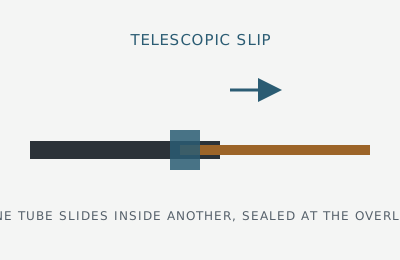
Representative example — real Uma Bellows expansion joint:

How it works
The overlap between the inner and outer tube is sealed, typically with packing or a short bellows element, while the tubes themselves do the work of accommodating the large travel distance. This trades some of a bellows joint's inherent sealing simplicity for a much greater movement range.
- Accommodates axial travel beyond standard bellows convolution limits
- Overlap is sealed with packing or a supplementary bellows element
- Used where large thermal growth must be absorbed in a compact length
- A different working principle from convoluted bellows, not a bellows variant
Related: Axial Expansion Joint · Expansion Joints · High-Pressure Bellows
Request a Quote