
Expansion Joint Configurations
Torsional Bellows
Unlike a swivel joint, which isolates the bellows from rotation via a bearing, a torsional bellows takes the twisting load directly in its own convolutions — a specialized, lower-duty configuration for applications with a genuine torsional requirement rather than simple axial or lateral movement.
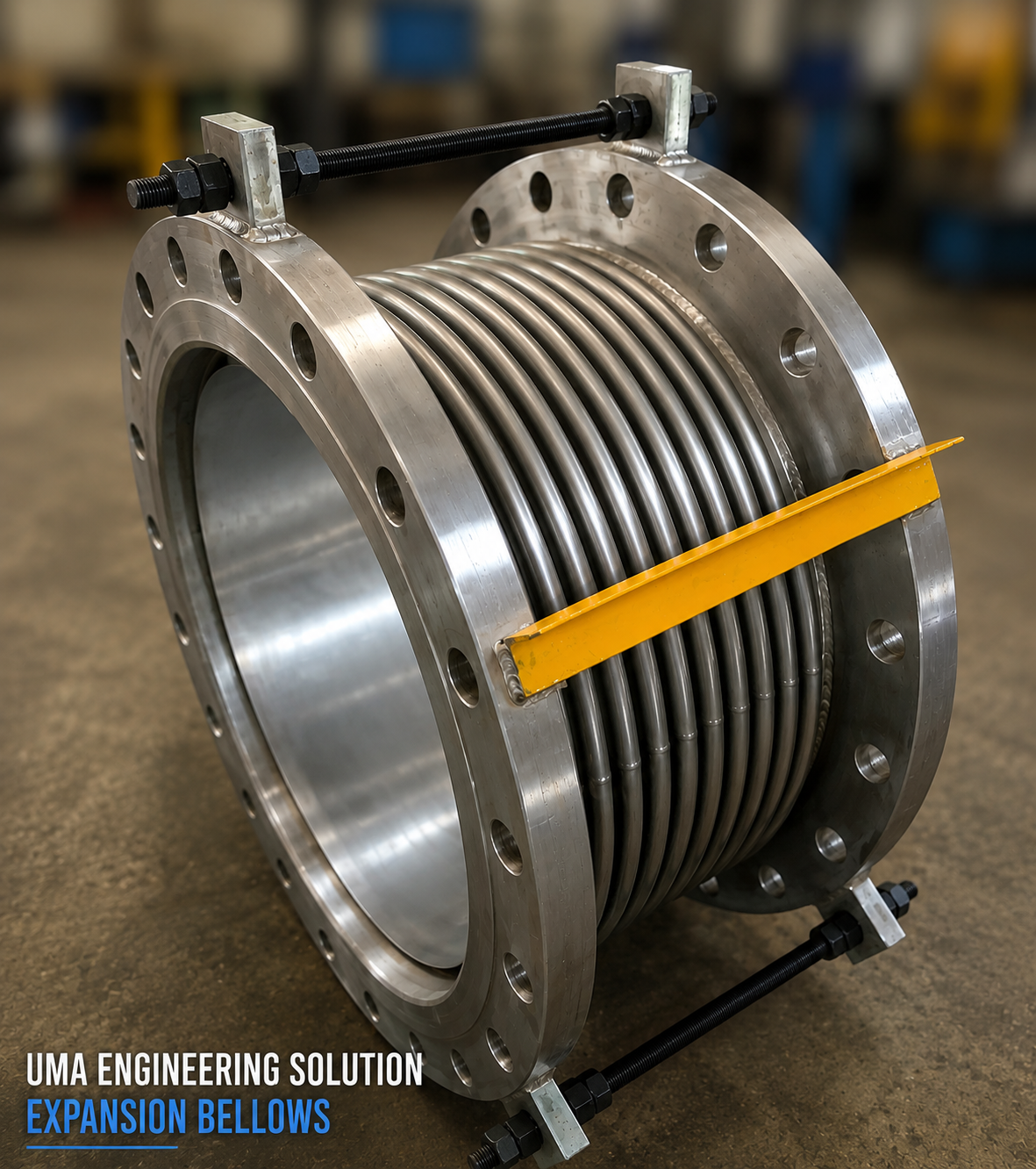
Representative example — real Uma Bellows expansion joint:
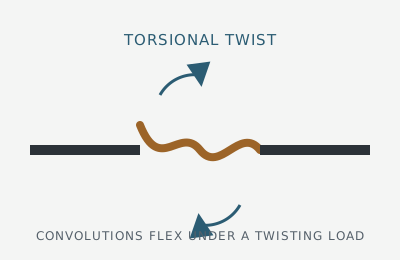
How it works
The convolutions deform under torque in addition to (or instead of) axial compression, which is a more demanding stress case than axial movement alone — torsional bellows are typically specified only where the application genuinely calls for it.
- Convolutions absorb twisting load directly, not via a bearing
- A specialized, lower-duty configuration versus swivel joints
- Stress analysis for torsion differs from standard axial design
- Specified only where genuine torsional movement is expected
Related: Swivel Expansion Joint · Axial Expansion Joint · Expansion Joints
Request a Quote